
How Much Can You Save with a Low Power P5 Outdoor LED Display?
A low power P5 outdoor LED display is increasingly becoming the preferred choice for American signage owners, property managers, and outdoor advertisers who want high visibility without high utility bills. In this post, we’ll break down why P5 is a smart pixel pitch for outdoor fixed installations,
5/7/20263 min read
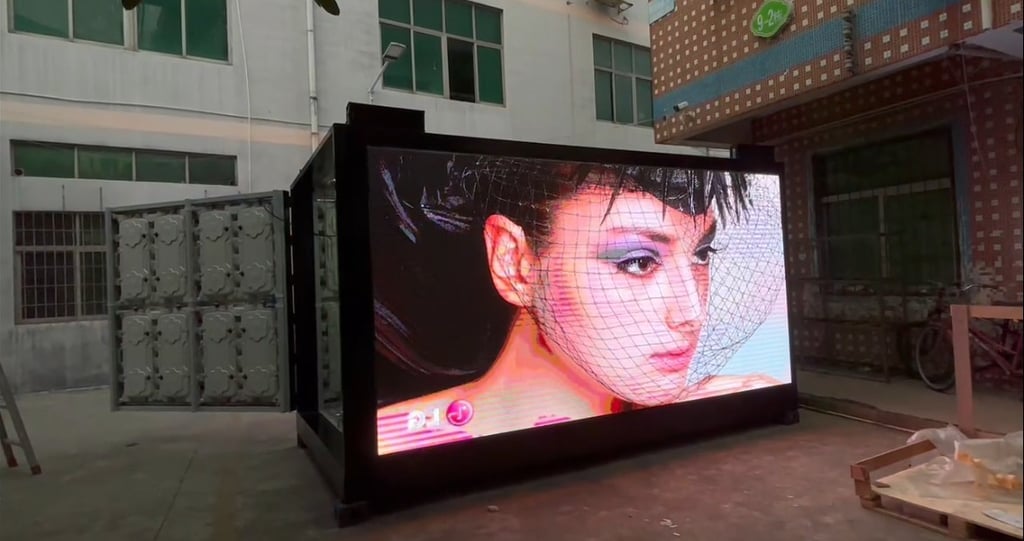
How Much Can You Save with a Low Power P5 Outdoor LED Display?
When planning an outdoor LED billboard or digital signage project in the U.S., most buyers focus first on brightness and pixel pitch. But there’s one hidden cost that quietly eats into your ROI every month: electricity.
A low power P5 outdoor LED display is increasingly becoming the preferred choice for American signage owners, property managers, and outdoor advertisers who want high visibility without high utility bills. In this post, we’ll break down why P5 is a smart pixel pitch for outdoor fixed installations, how modern low-power designs work, and what kind of energy savings you can realistically expect in U.S. market conditions.
Why P5 Is Still a Sweet Spot for Outdoor Fixed Installations
P5 (5mm pixel pitch) remains one of the most balanced choices for outdoor LED billboards, roadside digital signs, and building-mounted displays where typical viewing distances range from 15 to 100 feet (≈5–30 meters).
Compared with finer pitches like P3/P4, P5 offers:
lower pixel density (40,000 pixels/㎡), which naturally reduces driving current and heat
excellent readability for logos, text, and full-motion ads
a strong price-to-performance ratio for medium-to-large format outdoor screens
For many U.S. outdoor advertising locations—highway corridors, retail centers, gas stations, auto dealerships—P5 hits the visual clarity customers need without over-specifying resolution you can’t perceive at distance.
What “Low Power” Really Means for Outdoor LED Screens
Not all “energy saving” claims are equal. True low power design isn’t just about lowering brightness until the image suffers. In well-engineered P5 outdoor LED displays, power optimization comes from electrical architecture and component-level efficiency, such as:
Optimized drive ICs and current control to reduce unnecessary dissipation
Efficient power supply design with better conversion efficiency
Smart brightness control (auto-dimming based on ambient light) to cut power when full brightness isn’t needed—especially valuable for U.S. markets with strict light-control expectations in certain cities
Optional common-cathode / dual-voltage architectures that deliver closer-to-required voltage to red vs green/blue LEDs, reducing excess heat and wasted energy
The result: you can still run ≥6000 nits peak brightness for daylight visibility, while keeping average power in a much more manageable range.
Typical Power Consumption: Low Power P5 vs Conventional P5
Numbers vary by configuration, but for planning purposes, many U.S. buyers compare like this:
Conventional P5 Outdoor LED Display Low Power P5 Outdoor LED Display
Max power consumption ~700–900 W/㎡ ~500–650 W/㎡
Average power consumption ~350–450 W/㎡ ~150–220 W/㎡
Typical brightness ≥6000 nits ≥6000 nits
Heat generation Higher (may require more thermal care) Lower (easier natural cooling)
Actual values depend on brightness setting, content type, duty cycle, cabinet design, and power supply efficiency.
For a mid-size outdoor billboard, that difference in average power can translate into meaningful monthly electricity savings—and over a multi-year operation, those savings often outweigh small differences in upfront hardware cost.
Why Low Power Matters in the U.S. Market
Several practical factors make low power P5 outdoor LED displays especially attractive for U.S. projects:
Electricity rates: In many states, commercial power isn’t cheap. Reducing watts per square meter directly improves operating margin for ad-driven screens.
Duty cycles: Many outdoor signs run 14–24 hours a day. Power adds up fast.
Thermal management: Lower power means less heat, which can simplify enclosure design, reduce fan load, and help electronics age more predictably.
Sustainability expectations: More U.S. buyers ask about energy efficiency and lifecycle cost, not just “price per panel.”
Where Low Power P5 Outdoor LED Displays Are Commonly Used
Highway and roadside digital billboards
Retail strip centers and shopping plazas
Gas stations and convenience stores
Auto dealerships and outdoor lot signage
Stadium perimeters and sports facilities
Municipal information signs and transit-adjacent displays
Key Specifications (Example – U.S. Project Reference)
Item Typical Value
Pixel pitch 5 mm
LED type SMD2727 / SMD1921 (outdoor)
Brightness ≥6000 nits (auto-dimming supported)
Average power consumption ~150–220 W/㎡ (low power design)
Refresh rate ≥1920–3840 Hz
Viewing angle H140° / V140°
IP rating IP65 front / IP54 or IP65 rear
Cabinet size 960×960 mm / 640×640 mm (customizable)
Operating temp -20℃ ~ +60℃
Final specs are confirmed in quotation based on cabinet style, power design, and control system.
How to Estimate Your Project’s Energy Savings
A simple way U.S. buyers compare options:
Confirm average watts/㎡ for each candidate display.
Multiply by total screen area (㎡) → average running watts.
Estimate daily run hours (e.g. 14h or 24h).
Convert to kWh/day, then kWh/month.
Apply your local $/kWh commercial rate.
CONTACT US
WHATSAPP:0086-19875446302
joey@ledsigns.us
© 2024. All rights reserved.




US Office: West 90th Place Bridgeview, IL 60455,USA
CONNECT
Technology Support: Hunter@ledsigns.us